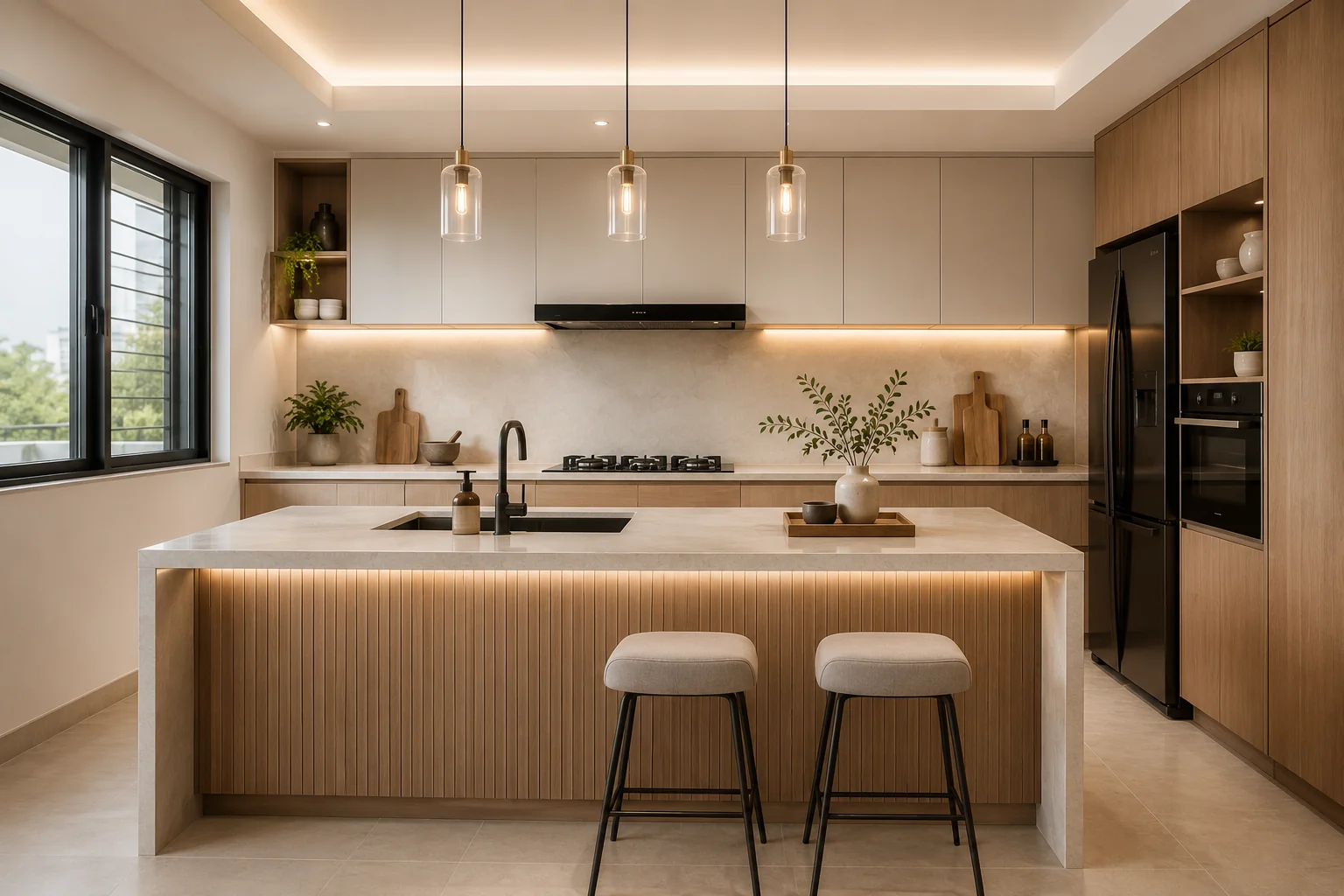
Quick answer
A simple BTO kitchen refresh may stay around S$8,000–S$15,000, while a full resale HDB kitchen rebuild with hacking, new tiles, custom cabinetry, plumbing and electrical works can reach S$20,000–S$35,000 or more. The final number depends less on the word “kitchen” and more on what must be removed, rebuilt, concealed and customised.
Basic BTO kitchen refresh
S$8,000 – S$15,000
Usually lighter works, less hacking and fewer hidden site issues.
HDB resale kitchen renovation
S$15,000 – S$28,000+
Often includes hacking, haulage, tiling, plumbing updates and rectification.
Condo kitchen renovation
S$18,000 – S$35,000+
Costs may increase with management rules, protection works and appliance integration.
Premium custom kitchen
S$35,000 – S$60,000+
Applies when there are premium slabs, tall units, island counters and complex detailing.
Typical kitchen renovation cost in Singapore
These ranges are planning references, not fixed packages. Two kitchens with the same floor area can differ greatly if one requires hacking, plumbing rerouting, premium worktops or full-height custom carpentry.
BTO kitchen
S$8,000 – S$15,000
Suitable when the layout is simple and major hacking is not required.
4-room or 5-room HDB resale kitchen
S$15,000 – S$28,000+
Budget more when existing cabinets, sink support, wall tiles and floor tiles must be removed.
Condo kitchen
S$18,000 – S$35,000+
MCST rules, lift protection, hacking hours and concealed services can affect planning.
Open-concept or island kitchen
S$30,000 – S$50,000+
The cost rises with island carpentry, large worktops, lighting and appliance coordination.
What actually makes a kitchen renovation expensive?
Often 30–50% of the kitchen budget
Carpentry
Top and bottom cabinets, tall units, internal hardware and custom finishing add up quickly.
Moderate to high impact
Worktop material
Quartz is practical for many homes; sintered stone costs more but gives better heat resistance and a premium look.
High impact for resale homes
Hacking and haulage
Old wall tiles, floor tiles, sink supports and built-in structures require labour and disposal.
Depends on layout changes
Plumbing and electrical
Sink relocation, hood points, oven points, concealed wiring and older pipes can increase cost.
Often underestimated
Appliance integration
Built-in ovens, dishwashers, fridge panels and exact dimensions must be planned before fabrication.
Quotation check
How to compare kitchen renovation quotations properly
A kitchen quotation should not be judged by the total price alone. In Singapore, the real difference is often whether the quote includes hacking, haulage, making-good works, plumbing coordination, electrical points, worktop cut-outs, GST and appliance-related preparation.
This matters because kitchen renovation touches regulated and technical works. HDB renovation works may require approval before works begin, regulated plumbing works must be carried out by Licensed Plumbers, and electrical wiring or new power points should be handled by Licensed Electrical Workers. Gas-related works also need proper safety coordination before renovation starts.
Before signing, ask the contractor to separate visible finishes from site-preparation and technical works. A cheaper quote may only cover carpentry and surface materials, while a more complete quote may already include demolition, disposal, sink support removal, wall patching, plumbing reconnection, electrical additions and final cleaning.
- Check whether hacking, haulage, disposal and site cleaning are included.
- Confirm whether making-good works after removing old cabinets, sink supports, tiles or built-ins are included or provisional.
- Ask whether plumbing reconnection, sink relocation, drainage adjustments and Licensed Plumber coordination are included.
- Clarify whether electrical points for oven, hood, hob, fridge, dishwasher and small appliances are included or charged separately.
- Confirm whether worktop sink and hob cut-outs, edge finishing, backsplash, joints and silicone works are included.
- Check whether GST, condo protection works, lift padding, management application fees or debris handling are included.
- Do not finalise the quote until appliance dimensions, sink model, hob type, hood type and gas or induction decision are confirmed.
Carpentry
Kitchen carpentry is usually the biggest cost component
For most Singapore kitchens, cabinetry has the biggest influence on the final price. A kitchen with only bottom cabinets will cost very differently from one with top cabinets, tall units, internal pull-out baskets, appliance towers and special finishes.
The cheapest cabinet is not always the cheapest long-term decision. Kitchens face heat, moisture, oil, cleaning chemicals and daily use. Poor-quality laminate, weak hinges or badly planned storage can become expensive to rectify later.
- Bottom cabinets and top cabinets are usually priced by length.
- Tall units, appliance towers and full-height storage cost more because they use more material and internal structure.
- Soft-closing systems, premium hinges, drawers and pull-out accessories increase cost but improve durability and daily use.
- Curved panels, fluted details, hidden handles and boutique profiles should be budgeted as custom carpentry, not basic carpentry.
Specifications
The same-looking kitchen can be priced differently because the specifications are different
Two kitchen quotations can show the same cabinet length and still describe very different products. The difference is often hidden in the specifications: cabinet carcass material, internal laminate, door finish, hinges, drawer runners, worktop thickness, backsplash height, edge profile, number of drawers and how appliances are integrated.
This is why a homeowner should not compare kitchen carpentry by length alone. A basic cabinet with simple swing doors is not the same as a kitchen with tall storage, heavy-duty drawers, soft-closing hardware, internal accessories, a full-height backsplash and a premium worktop.
For worktops, quartz is commonly selected because it is practical and low-maintenance, while sintered stone is usually chosen when the homeowner wants better heat resistance, a thinner premium look or larger-format surfaces. The correct choice depends on cooking habits, budget, edge detail, installation complexity and how carefully the surface will be used.
- Ask what cabinet carcass material is being used, and whether exposed or internal areas are properly finished.
- Confirm whether the quoted cabinet price includes top cabinets, tall units, drawer units, internal accessories and soft-closing hardware.
- Check whether the worktop price includes backsplash, sink and hob cut-outs, edge profile, joints, silicone and installation.
- Compare quartz and sintered stone by usage, heat exposure, chip risk, repairability, visual effect and budget — not only by material name.
- Clarify whether premium details such as fluted panels, curved corners, hidden handles, glass doors, LED lighting and appliance towers are included.
- Before signing, ask the contractor to write down the specification clearly so later upgrades do not become variation orders.
Resale homes
Why resale kitchen renovation costs more
Resale kitchens usually cost more because the contractor is not starting from a clean base. Before the new kitchen can be built, the old cabinets, worktop, wall tiles, floor tiles, plumbing points and electrical points may need to be removed or corrected.
After hacking, the real condition of the site becomes clearer. Uneven walls, hollow tiles, old pipe routes, damaged plaster and missing tiles under old built-ins can all create additional work before carpentry can be installed properly.
- Hacking and haulage are common in resale kitchens.
- Old wall and floor finishes may reveal uneven surfaces after removal.
- Existing plumbing points may not suit the new sink, dishwasher or washing machine location.
- Older electrical points may not be suitable for modern ovens, hobs, hoods or additional appliances.
Site assessment
Hidden kitchen costs are usually discovered before or during hacking
The most dangerous kitchen budget is one that assumes the site is already ready for new carpentry. In resale HDB flats and older condos, many cost differences only appear after the old cabinets, tiles, sink support and existing services are inspected or removed.
This is why a site assessment matters before accepting a quotation. HDB renovation works may require approval before commencement, regulated plumbing work must be handled by a PUB Licensed Plumber, and new wiring or electrical extensions should be carried out by Licensed Electrical Workers. These are not decorative choices; they affect whether the kitchen can be built safely and correctly.
A proper kitchen discussion should therefore separate design cost from site-readiness cost. The homeowner should know what is confirmed, what is provisional, and what can only be finalised after hacking or inspection.
- Old tiled sink support: removal may reveal missing floor tiles, uneven levels or old pipe routes.
- Wall and floor condition: hollow tiles, weak plaster or uneven surfaces can require patching, screeding or relaying before new work starts.
- Concealed plumbing: sink, washer or dishwasher relocation may need Licensed Plumber coordination and cannot be priced like a simple cabinet change.
- Electrical loading and points: ovens, induction hobs, hoods, fridges and dishwashers may require additional points or circuit planning by a Licensed Electrical Worker.
- Gas coordination: gas pipe alteration, termination or reconnection should be planned before carpentry and appliance positions are fixed.
- Appliance mismatch: late confirmation of fridge, hob, hood, oven or dishwasher dimensions can lead to carpentry variation or rework.
- Condo logistics: MCST rules, lift protection, hacking hours and debris handling can affect cost even when the kitchen size is similar.
Planning sequence
Plan appliances, power, plumbing and gas before carpentry
A kitchen layout should not be finalised from cabinet dimensions alone. Before carpentry is fabricated, the homeowner should confirm the appliance list, sink position, hob type, hood type, fridge clearance, oven height, dishwasher or washer location, lighting points, power points, plumbing route and gas requirement.
This is where many kitchen renovation variations happen. HDB advises homeowners to know the flat's electrical loading when planning electrical appliances, PUB requires regulated plumbing works to be carried out by Licensed Plumbers, and gas pipe alteration or supply turn-on has to be coordinated safely before the kitchen is completed.
A practical way to plan is to lock the technical items first, then design the cabinets around them. If the induction hob, oven, dishwasher, hood or gas pipe route is confirmed too late, the carpentry may need to be altered, additional points may be required, or installation may be delayed.
- Confirm the exact fridge, oven, hob, hood, dishwasher and washer dimensions before carpentry measurement.
- Decide early between gas hob and induction hob because this affects gas coordination, electrical loading and countertop cut-outs.
- Check whether the oven, induction hob or other high-capacity appliances need dedicated power points or circuit planning.
- Plan sink, dishwasher and washing machine positions together so plumbing and drainage are not treated as an afterthought.
- Allow clearance for fridge doors, drawer opening, tall cabinet doors, service access and ventilation around built-in appliances.
- Confirm hood type and ducting or recirculation approach before designing top cabinets.
- Finalise appliance specifications before worktop fabrication because sink and hob cut-outs cannot be guessed accurately.
Approvals
HDB, condo and site constraints matter
For HDB flats, renovation works are subject to HDB guidelines, and some works require approval before commencement. Hacking, changes to wall or floor finishes, and works affecting wet areas should never be treated casually.
For condos, the management office and MCST rules can affect renovation hours, lift protection, debris disposal, noisy works and application procedures. Even when the design is simple, the approval and site-management process can affect the renovation timeline.
- Confirm permit and approval requirements before hacking starts.
- Check condo management rules before scheduling noisy works.
- Plan material delivery, lift protection and debris removal early.
- Do not finalise carpentry before plumbing, appliance dimensions and site conditions are confirmed.
Older HDB sink supports can increase renovation complexity
Some older Singapore HDB kitchens use tiled concrete sink supports instead of modern modular kitchen bottom cabinets. This means tiles or masonry were used to build up the base that supports the sink and countertop.
When this old sink support is hacked away, there may not be finished floor tiles beneath it. The support may have been built directly onto the original slab or over an unfinished area during an earlier renovation.
This is why older resale HDB kitchens need careful site inspection. Removing the sink support can expose missing tiles, uneven floor levels, old pipe routes or surfaces that need patching before new cabinets can be installed properly.
Possible added works
- Patching missing floor areas after demolition.
- Levelling uneven surfaces before new carpentry goes in.
- Additional tiling or making-good works.
- Concealed plumbing adjustments around the sink area.
- Extra hacking, haulage and site-cleaning labour.
Quartz vs sintered stone worktops
Worktop choice affects not only cost, but also cooking habits, maintenance and the overall feel of the kitchen. In Singapore homes, quartz remains a practical choice for many families, while sintered stone is often selected for a more premium finish and better heat resistance.
Quartz
Moderate
Durable and practical for most homes, but homeowners should still avoid placing very hot cookware directly on the surface.
Sintered stone
Higher
More heat-resistant and visually premium, suitable when the kitchen design calls for a thinner or more refined slab look.
Waterfall edge or large backsplash
Additional cost
Looks premium, but increases material usage, fabrication and installation complexity.
Sink and hob cut-outs
Must be included
Cut-outs, joints and edge finishing should be checked before comparing worktop quotations.
Should you overlay or hack existing kitchen tiles?
Overlaying tiles can reduce cost and mess, but it is not always the right answer. The existing tile condition, floor height, drainage slope and long-term durability must be checked before deciding.
Overlay existing tiles
Lower upfront cost
Works best when existing tiles are sound, flat and suitable for overlay. Not ideal if tiles are hollow, loose or uneven.
Hack and relay tiles
Higher upfront cost
More labour and disposal, but gives a cleaner base when existing finishes are old or unreliable.
Partial making-good
Depends on condition
Common in resale kitchens after cabinets, sink supports or built-ins are removed.
Realistic kitchen renovation budget examples
4-room BTO kitchen
Around S$10,000 – S$15,000
- Standard top and bottom cabinets
- Quartz worktop
- Basic plumbing connection
- Limited hacking or no hacking
- Simple lighting and power-point planning
4-room HDB resale kitchen
Around S$22,000 – S$35,000
- Full hacking of old cabinets, tiles and sink support
- New wall and floor finishes
- Custom carpentry with quartz or sintered stone
- Plumbing adjustment and electrical upgrades
- Making-good works after demolition
Condo open-concept kitchen
Around S$30,000 – S$50,000+
- Island counter or extended peninsula
- Premium worktop and backsplash
- Integrated appliances
- Concealed lighting details
- MCST coordination and protection works
How to budget properly for a kitchen renovation
- Start with the workflow: sink, hob, fridge, preparation area and storage should be planned before choosing decorative finishes.
- Set aside a contingency buffer, especially for resale HDB and older condo kitchens.
- Confirm appliance dimensions early so the carpentry can be fabricated accurately.
- Spend first on durable areas: cabinet structure, worktop, hinges, plumbing and electrical safety.
- Avoid comparing quotations only by total price. Check whether hacking, haulage, sink support removal, cut-outs, GST and making-good works are included.
Useful planning tools and related guides
Renovation Cost Calculator
Estimate a realistic planning range before asking for quotations.
Renovation Quotation Singapore
Learn why kitchen quotations can vary depending on exclusions, site risks and material specifications.
Buying Renovation Items Overseas
Check what to confirm before sourcing sinks, taps, appliances or kitchen fittings from overseas.
Renovation Cost Singapore Guide
Understand whole-home renovation cost ranges for HDB, condo and resale homes.
Renovation Mistakes Singapore Homeowners Make
Avoid common planning, quotation and site coordination mistakes.
HDB Renovation Timeline Singapore
Plan the renovation sequence, approval timing and handover expectations.
Kitchen renovation cost FAQ
How much does kitchen renovation cost in Singapore?
Most kitchen renovations in Singapore range from S$8,000 to S$35,000+. A basic BTO kitchen can be below S$15,000, while a full resale kitchen rebuild with hacking, tiling, custom carpentry, plumbing and electrical works can exceed S$30,000.
Why do resale HDB kitchen renovations cost more?
Resale kitchens usually involve removal of old cabinets, tiles, worktops and sometimes tiled sink supports. After hacking, the contractor may also need to patch missing tiles, level surfaces, adjust plumbing and make good old wall or floor areas.
What is an HDB kitchen sink support?
Some older HDB kitchens use tiled concrete or masonry sink supports instead of modern cabinet bases. When removed, there may be no finished floor tiles below the support, which can create extra patching, tiling and levelling works.
How much does kitchen carpentry cost in Singapore?
Kitchen carpentry cost depends on length, cabinet height, internal hardware, material selection and design complexity. It is often the largest part of the kitchen budget and can account for 30–50% of the total cost.
Is quartz or sintered stone better for kitchen worktops?
Quartz is practical and commonly used for Singapore homes. Sintered stone costs more but offers better heat resistance and a more premium appearance. The better choice depends on cooking habits, budget and design expectations.
Can I renovate my kitchen without hacking?
Yes, if the existing tiles and layout are suitable. Some homeowners keep the floor and wall finishes, then change carpentry, worktop and fittings. However, for older resale kitchens with hollow tiles, sink supports or poor existing finishes, hacking may be more reliable.
Should I overlay or hack kitchen tiles?
Overlaying is usually cheaper and faster, but it depends on existing tile condition. If the tiles are hollow, uneven, loose or affected by old works, hacking and relaying may provide a better long-term base.
How long does a kitchen renovation take?
A straightforward kitchen renovation may take a few weeks, while resale kitchens with hacking, tiling, plumbing, electrical works and custom carpentry coordination can take longer. Carpentry fabrication and site readiness are usually key timeline factors.
Why do kitchen renovation quotations vary so much?
Quotations vary because some include hacking, haulage, making-good works, sink support removal, worktop cut-outs, GST and electrical points, while others only show basic carpentry and visible finishes. Always compare scope, not only total price.
How much contingency should I prepare for a kitchen renovation?
For a new BTO kitchen, a smaller contingency may be enough. For resale HDB or older condo kitchens, it is safer to prepare a larger buffer because hidden site conditions are only fully revealed after demolition.
Planning a kitchen renovation in Singapore?
Use ID Work Studio’s renovation cost calculator first to understand a realistic budget range. If you are renovating a resale HDB kitchen, we can also review the likely hacking, sink support, tiling and carpentry considerations before you commit to a scope.