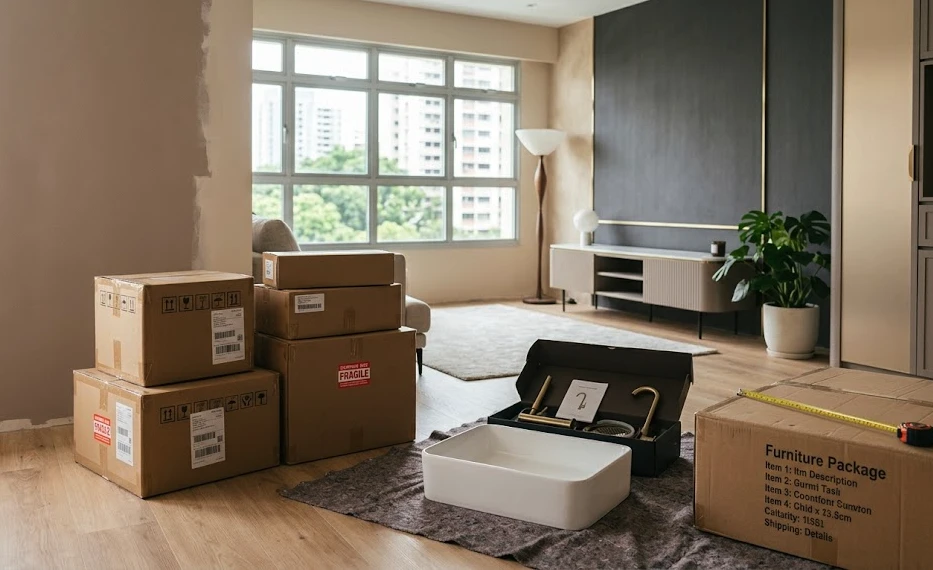
Quick answer
Yes, Singapore homeowners can buy selected renovation items overseas, but bulky furniture, plumbing fittings, electrical appliances, tiles and fragile sanitary items carry higher risk. Before ordering, check lift access, exact measurements, Singapore voltage, SAFETY Mark requirements, PUB WELS rating, warranty support, spare parts, shipping protection and delivery timing with your renovation schedule.
Furniture
Size & delivery risk
A sofa or dining table may look perfect online but fail to fit into an HDB lift, condo service lift, staircase turning point or actual living room layout.
Taps & showers
Fitting & WELS risk
Imported mixers, taps and rain shower sets may not match local pipe fittings, water pressure expectations or Singapore water-efficiency labelling requirements.
Appliances
Voltage & SAFETY Mark risk
US and Japan appliances may run on different voltage, while certain controlled goods sold in Singapore require a valid SAFETY Mark.
Tiles & fragile items
Delay & damage risk
Damaged tiles, basins, vanity cabinets or wrong quantities can stop work on site and push back tiling, carpentry and handover dates.
Why this matters for Singapore renovation projects
Overseas shopping is not automatically a bad idea. Many homeowners use Taobao, Amazon US, China suppliers or overseas platforms because the designs are wider and the prices can look attractive before shipping.
The real issue is that renovation items are not like normal online shopping. Once hacking, tiling, plumbing, carpentry or electrical work depends on an item, a wrong dimension or incompatible fitting can affect the whole project sequence.
For BTO, resale HDB, condo and landed homes in Singapore, the safest approach is not to avoid overseas purchases entirely. The safer approach is to separate what can be bought freely from what must be checked carefully before ordering.
Oversized furniture is one of the most common overseas-buying mistakes.
1. Furniture: the online photo does not show whether it fits your home
A sofa, bed frame, dining table or long TV console may look proportionate in a showroom photo, but overseas listings are often photographed in larger homes. A piece that looks normal online can feel oversized inside a 4-room HDB living room or a compact condo layout.
The bigger problem is delivery access. Length, depth and height are not enough. You also need to consider lift size, corridor width, staircase turning radius, entrance door clearance and whether condo management requires service-lift booking.
- Check the packed carton size, not only the assembled product size.
- Measure lift depth, lift door width, main door width and corridor turning space.
- For L-shaped sofas and marble tables, confirm whether the item can be split into smaller parts.
- Mark the furniture footprint on the floor plan before ordering, especially walkway clearance and chair pull-out space.
2. Product quality: “item not as described” is harder to solve overseas
For loose furniture and accessories, the common risk is not only damage. It is the difference between what the listing promises and what arrives. The colour may be different, the fabric may feel thinner, the foam may be softer than expected, or the wood may be veneer instead of solid wood.
This is easier to accept for small decorative items. It is much harder when the item is a sofa, dining set, vanity cabinet or built-in-looking feature piece that your renovation design has already been planned around.
- Ask for real buyer photos, not only catalogue images.
- Check whether the seller shows actual material thickness and close-up finishing.
- Avoid relying only on translated descriptions for material quality.
- For expensive items, ask your designer or contractor whether the scale and material make sense before ordering.
A beautiful fitting is useless if it cannot connect properly or perform safely.
3. Plumbing fittings: taps and rain shower sets may not match local requirements
Imported taps, mixers, rain shower sets and concealed shower systems can create problems when thread size, connector type or installation depth does not suit Singapore site conditions. Some US products may use different fitting conventions, while some overseas products need adapters that affect finishing or long-term maintenance.
Singapore also has water-efficiency requirements. PUB’s Mandatory Water Efficiency Labelling Scheme uses a 0, 1, 2 and 3 tick rating to show water efficiency for covered products. Taps, mixers, flushing cisterns and some water fittings may need to meet local labelling and compliance requirements before they can be offered, displayed or advertised for sale and installation in Singapore.
- Check whether the tap, mixer or flushing product has Singapore PUB WELS information.
- Confirm with your plumber before buying concealed mixers or wall-mounted fittings.
- Do not assume an adapter will solve every pipe-connection problem neatly.
- For concealed shower mixers, wrong body depth can cause hacking or retiling later.
4. Electrical appliances: voltage, frequency and SAFETY Mark must be checked
Singapore’s standard household electricity supply is commonly 230V at 50Hz. Appliances from the US are often designed for around 110V to 120V, while Japan commonly uses 100V. A plug adapter only changes the plug shape; it does not automatically make the voltage suitable.
For certain household electrical and gas appliances sold in Singapore, the SAFETY Mark is part of the local consumer product safety framework. Controlled goods must be tested to specified safety standards and affixed with a SAFETY Mark before they can be sold in Singapore.
Homeowners should be careful with ovens, hobs, electric stoves, water heaters, smart toilets, wine chillers, coffee machines, designer lights and motorised appliances. If an imported item is not locally supported, repair technicians may not carry parts or may decline to service it.
- Check input voltage and frequency on the product label before buying.
- Do not assume a step-up or step-down transformer is ideal for long-term daily use.
- For controlled goods, check whether the product requires and carries a valid Singapore SAFETY Mark.
- Ask whether local warranty, servicing and spare parts are available in Singapore.
5. Warranty and repair: overseas savings can disappear later
The upfront price of an imported appliance, tap or smart toilet may be lower, but warranty is often where the real difference appears. Some sellers only support warranty in the country of purchase. Some require the product to be shipped back. Some cannot provide parts after a few years.
This becomes frustrating when the item is installed into your renovation. A faulty tap, concealed mixer, smart toilet, cooker hood or built-in appliance is not always easy to remove without affecting surrounding carpentry, tiles or plumbing.
- Ask whether warranty is valid in Singapore before ordering.
- Check whether the brand has a local service centre or parts supplier.
- Keep invoices, product model numbers and installation manuals.
- Avoid unknown brands for items that are difficult to uninstall later.
6. Shipping damage: fragile items need better protection
Vanity cabinets, ceramic basins, mirrors, sintered stone tops, marble tables, glass lights and tiles can be damaged during international shipping. Even if the seller agrees to compensate, the timeline loss may still affect your renovation schedule.
For fragile or expensive items, wooden crating is usually worth considering. It costs more, but it reduces the chance of cracks, chips and crushed corners during handling.
- Ask for wooden crating for ceramic, glass, stone or mirror items.
- Check whether shipping insurance covers visible damage and concealed damage.
- Inspect items immediately when they arrive at the warehouse or home.
- Photograph the packaging before opening if there are signs of damage.
7. Delivery timing: bulky items should not arrive too early
Many homeowners order early because they are afraid of shipping delays. That is understandable, but early delivery creates another problem. If the home is still under renovation, large furniture and fragile items can become obstacles on site.
Workers still need space for tiling, carpentry, painting, electrical work and cleaning. A bulky sofa, dining table or vanity cabinet sitting in the middle of the home can be scratched, covered in dust or accidentally damaged.
- Use a forwarder or warehouse that can hold bulky items until the site is ready.
- Coordinate delivery after dusty works, painting and major carpentry movement are completed.
- Avoid delivering loose furniture before final cleaning unless storage is properly protected.
- Book condo or MCST delivery slots early if service lift access is required.
A home can look better when it evolves slowly.
8. Soft decoration: do not rush to complete everything before moving in
Many homeowners want the completed home to look perfect on handover day. This often leads to buying too many cushions, lamps, rugs, side tables, display items and wall decor before living in the space.
The more practical approach is to move in first, understand your actual habits, then decorate gradually. After a few weeks, you will know where you really need a lamp, which corner feels empty, whether the sofa needs cushions, and how much display storage you actually use.
- Cushions, lamps, rugs and display decor can be added later without affecting renovation quality.
- Avoid buying all decorative items in one shipment just to make the home look complete immediately.
- Live in the home first before deciding on final layers of styling.
- Spend more attention on permanent items first: layout, electrical points, lighting plan, carpentry and waterproofing.
High-risk material
Special warning: buying tiles from overseas
Tiles are one of the riskiest renovation items to import because they affect site sequence, quantity planning, colour consistency and breakage allowance.
If you buy too many
You pay for extra tiles, extra shipping and may need storage space for unused boxes. Large-format tiles can be difficult to store safely after renovation.
If you buy too few
Reordering can delay tiling work. The tiler may not be able to continue, and later carpentry, doors, shower screens or sanitary installation may also be pushed back.
If the batch is different
Tiles from a later production batch may have slight shade or texture differences. Patchwork can become obvious, especially on feature walls or large open areas.
If tiles arrive damaged
Broken corners, cracked pieces or insufficient replacements can stop work. International claims may take longer than the renovation schedule can afford.
What is safer to buy overseas — and what needs more caution?
The safest rule is simple: the more permanent, technical, fragile or schedule-critical an item is, the more carefully it should be checked before buying overseas.
Generally safer to buy overseas
- Loose cushions and decorative objects
- Non-critical display accessories
- Loose side tables that are easy to replace
- Rugs and soft furnishings after size is confirmed
- Simple decorative lights only after voltage and installation are checked
Needs extra caution
- Tiles and stone materials
- Concealed shower mixers and built-in plumbing fittings
- Water heaters, ovens, hobs and other controlled electrical goods
- Oversized sofas, dining tables and bed frames
- Vanity cabinets with ceramic basins or fragile tops
Checklist before ordering renovation items overseas
Use this checklist before paying a deposit or confirming sea shipping. It can prevent many expensive mistakes.
Confirm actual dimensions
Check product size, packed size, weight, assembly method and whether the item can be separated for delivery.
Check access route
Measure lift, corridor, staircase, main door and service lift restrictions before buying bulky furniture.
Verify plumbing compatibility
Ask your plumber about thread size, connector type, water pressure and whether PUB WELS information is relevant.
Verify electrical safety
Check voltage, frequency, plug type, SAFETY Mark requirement, local warranty and repair support.
Plan shipping protection
Use wooden crating for fragile ceramic, glass, stone, mirror or vanity items where possible.
Coordinate delivery timing
Avoid sending bulky items to the home before dusty works, painting and major installation works are completed.
Related renovation planning guides
Renovation Cost Singapore 2026
Understand how overseas purchases can affect your total renovation budget and contingency planning.
HDB Renovation Timeline Singapore
See how late deliveries, damaged tiles and missing fittings can delay the renovation sequence.
Biggest Renovation Mistakes Singapore Homeowners Make
Compare this overseas-shopping checklist with other common renovation planning mistakes.
Renovation Cost Calculator
Use the calculator to plan your main renovation budget before adding overseas-purchase risk buffers.
FAQ: buying renovation items overseas
Is it worth buying renovation items from Taobao or overseas platforms?
It can be worth it for selected loose furniture and decorative items, but high-risk items such as tiles, concealed plumbing fittings, electrical appliances and oversized furniture should be checked carefully before ordering.
Can US or Japan appliances be used in Singapore?
Not always. Singapore commonly uses 230V at 50Hz, while many US appliances use around 110V to 120V and Japan commonly uses 100V. A plug adapter does not solve voltage incompatibility. Check the appliance label and local safety requirements first.
Do imported electrical appliances need a Singapore SAFETY Mark?
Certain controlled goods sold in Singapore require a valid SAFETY Mark. Homeowners should check whether the appliance category is regulated and avoid assuming that overseas certification is the same as Singapore compliance.
Will home insurance cover a fire caused by an imported appliance?
Insurance terms vary. In a fire investigation, insurers may look at whether a non-compliant, unsuitable or wrongly installed appliance contributed to the incident. Homeowners should check their policy and avoid using appliances that do not suit Singapore electrical conditions.
Why do overseas taps or rain shower sets sometimes not fit in Singapore?
Fitting size, thread type, connector design, water pressure and installation depth can differ. For concealed fittings, the risk is higher because rectification may require hacking after tiles are installed.
What is WELS and why does it matter for taps and flushing products?
WELS is Singapore’s Water Efficiency Labelling Scheme. It uses tick ratings to show water efficiency for covered products such as taps, mixers and flushing fittings. Homeowners should check whether imported water fittings are suitable for Singapore requirements.
Should I buy tiles from China for my Singapore renovation?
It is possible, but risky. You must plan quantity, wastage, shipping damage, batch variation and replacement timeline carefully. If you buy too few or receive damaged tiles, tiling work may be delayed.
How many extra tiles should I order?
The exact allowance depends on tile size, layout, cutting pattern and site condition. Homeowners should ask the tiler or contractor before ordering. Buying too little may delay the job, while buying too much creates waste and storage problems.
Should bulky furniture arrive before renovation is completed?
Usually no. Bulky furniture can block workers, collect dust or get damaged during painting, carpentry or electrical work. It is better to use warehouse holding and deliver after major works are completed.
What renovation items should I not rush to buy?
Do not rush cushions, lamps, rugs, display items and other soft decoration. These can be added after moving in, when you understand your lifestyle, lighting habits and storage needs better.
What should I ask my contractor before buying overseas?
Ask whether the item fits the design, whether it affects plumbing or electrical works, whether it can be installed safely, whether delivery timing suits the schedule and whether spare parts or replacements are available locally.
Planning to mix local renovation works with overseas purchases?
ID Work Studio helps Singapore homeowners plan renovation sequencing, site measurements, material decisions and installation risks before costly items are ordered.