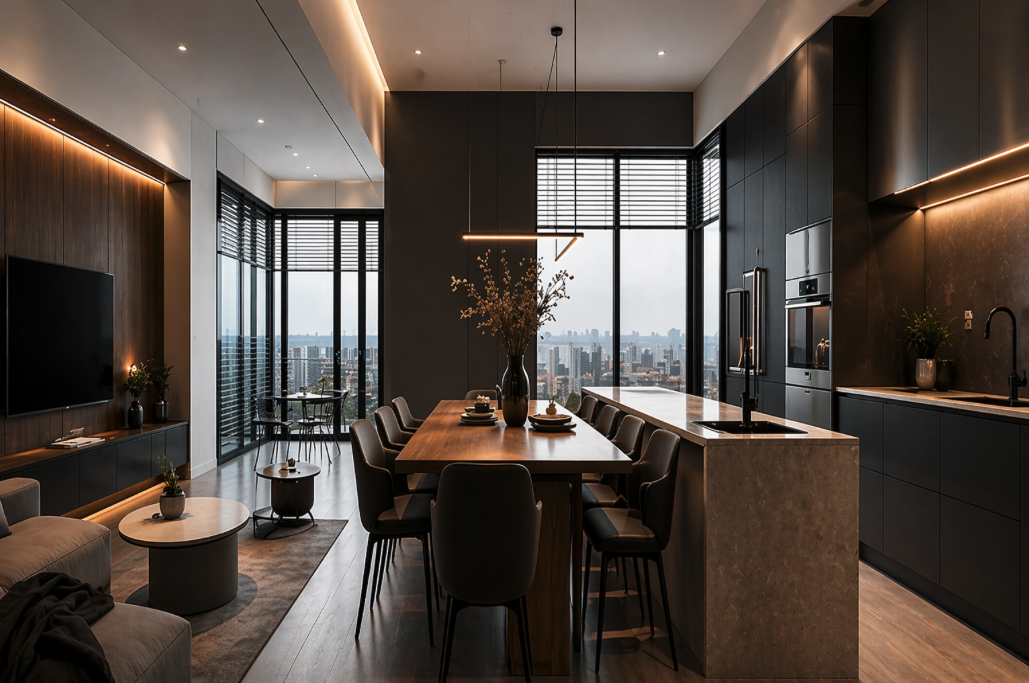
A realistic office renovation timeline in Singapore is not just the number of days spent on site. It must include design confirmation, landlord or MCST approval, possible SCDF/QP review, site works, M&E coordination, furniture delivery, testing and handover. This guide explains the timeline the way a contractor schedules it on a real project.
How long does office renovation take in Singapore?
As a working guide, a small office usually takes 3 to 6 weeks, a medium office takes 6 to 10 weeks, and a large or corporate office takes 10 to 16 weeks. These ranges include planning, approval, site works and handover. A simple refresh can be faster, but once partition, electrical, data, aircon or fire safety works are involved, the schedule must allow proper coordination.
Small office
3–6 weeks
Medium office
6–10 weeks
Large / corporate
10–16 weeks
If you are planning your office renovation timeline based on budget, read our office renovation cost guide in Singapore to understand how scope, M&E works, landlord requirements and approvals affect your total project cost.
Client concerns
What business owners usually worry about
Typical office renovation Gantt schedule
Office renovation works overlap. The Gantt chart below is easier for clients to read than a long site schedule, but it still shows the real sequencing: approval before major works, wet and partition works before final finishes, and testing before handover.
| Stage | W1 | W2 | W3 | W4 | W5 | W6 | W7 | W8 | Contractor note |
|---|---|---|---|---|---|---|---|---|---|
| Planning & design | Site survey, layout, M&E planning and quotation alignment. | ||||||||
| Landlord / MCST / SCDF approval | Runs in parallel after drawings are ready; complex fire safety items can extend this. | ||||||||
| Hacking & dismantling | Removal of existing partition, ceiling, flooring or built-ins where approved. | ||||||||
| Masonry & partition | New layout formation, drywall partition, wet works and base preparation. | ||||||||
| Electrical & data | Power points, lighting points, network cabling, server and workstation coordination. | ||||||||
| Aircon works | Diffuser relocation, thermostat adjustment, FCU coordination or duct changes. | ||||||||
| Carpentry & furniture | Fabrication is usually off-site; final installation depends on confirmed site measurements. | ||||||||
| Finishing works | Painting, flooring, glass works, lighting installation and final touch-ups. | ||||||||
| Testing & handover | Power, data, aircon, defects, cleaning and handover readiness. |
This is a working schedule, not a fixed promise. In Singapore office renovation, approval delays, after-hours restrictions, aircon shutdown coordination and supplier lead times can shift the programme by 1 to 3 weeks. A proper contractor schedule should always include buffer time.
For a full overview of office renovation requirements, including landlord approval, MCST submission and SCDF coordination where applicable, refer to our office renovation Singapore service page before confirming your lease handover and move-in schedule.
Owner Decision Timeline Before Renovation
One of the biggest misconceptions about office renovation is that the programme starts when work begins on site. In reality, the most important timeline belongs to the business owner. Decisions made several weeks before mobilisation determine whether the project progresses smoothly or suffers avoidable delays.
| When | Owner decision | Why it matters |
|---|---|---|
| 6–8 weeks before | Confirm lease, approvals and renovation objectives. | Changing the project brief later usually affects cost and programme. |
| 4–6 weeks before | Approve office layout, workstation count and meeting rooms. | Electrical, data, air-conditioning and furniture planning all depend on the final layout. |
| 3–4 weeks before | Confirm materials, finishes and long-lead items. | Imported flooring, glass or custom carpentry can extend the overall timeline if ordered late. |
| 1–2 weeks before | Coordinate IT, internet, furniture delivery and staff relocation. | Business continuity depends on these activities being aligned with the construction programme. |
Experienced commercial contractors do not simply plan construction activities—they help clients make the right decisions at the right time so approvals, procurement and site work can progress together.
Understand the Critical Path Before You Promise a Move-In Date
A renovation timeline is not delayed by every task equally. It is delayed by the tasks that control the next task. This is called the critical path. For an office renovation, the critical path is usually not painting or loose furniture. It is layout approval, building approval, M&E coordination, ceiling access, partition setting-out and handover testing.
| Critical path item | What it blocks | Consultant advice |
|---|---|---|
| Final layout approval | Partition, electrical, data, lighting, air-conditioning and furniture planning. | Do not start site work with a layout that is still changing. One moved meeting room can affect multiple trades. |
| Landlord or building management approval | Site access, lift booking, noisy work timing, protection works and commencement date. | Treat approval time as part of the renovation programme, not an administrative afterthought. |
| M&E coordination | Power points, data points, lighting, air-conditioning, ceiling works and fire safety coordination. | Confirm workstation count, server needs, meeting room equipment and pantry requirements before electrical works begin. |
| Ceiling and partition sequence | Lighting installation, aircon works, sprinkler or detector coordination and final painting. | Do not view ceiling, partition and services as separate items. They physically affect each other on site. |
| Testing and handover | Staff move-in, IT setup, furniture use, access control and operational readiness. | Leave time for testing. A finished-looking office is not ready if power, data, lighting or access systems are not tested. |
This is why two office renovation projects of similar size can have very different timelines. The faster project is usually not the one that rushes site work—it is the one where the blocking decisions are settled early and the trades are sequenced correctly.
Timeline Risk Matrix for Office Renovation Projects
A realistic office renovation timeline should not only show the expected sequence. It should also show the risks that can change the programme. In commercial projects, the common delay is not always slow workmanship. It is often an unresolved approval, a late owner decision, a service coordination issue or a building restriction that was not allowed for before work started.
| Timeline risk | Possible delay | How to reduce the risk |
|---|---|---|
| Landlord or building management approval | Several days to a few weeks, depending on the building's review process. | Submit drawings, method statements, insurance documents, protection plans and noisy-work requests before mobilisation. |
| Change-of-use or authority approval | Can affect the start date if the intended business use needs approval before renovation commitment. | Check the approved use early. Do not treat lease signing, change-of-use approval and renovation start as the same milestone. |
| Fire safety coordination | Depends on whether the new layout affects fire safety provisions or requires QP submission. | Flag enclosed rooms, altered partitions, ceiling changes and service routes early so fire safety implications can be checked before site work. |
| Electrical and data assumptions | Several days or more if the existing supply, DB location, workstation count or server needs were underestimated. | Confirm headcount, equipment load, server requirements, meeting room AV and pantry appliances before electrical works are priced and scheduled. |
| Late material or furniture confirmation | One to several weeks if selected finishes, loose furniture or custom items have lead times. | Separate fast-confirmation items from long-lead items. Do not wait until site work starts to choose critical finishes. |
| Occupied-office renovation | Longer programme because work may need to be phased around staff, meetings and business hours. | Decide early whether the office will be vacant, partially occupied or renovated in phases. This affects access, protection and productivity. |
The purpose of a risk matrix is not to make the timeline look longer. It is to make the timeline honest. A business owner should know which items can be controlled by early decisions, which items depend on third parties, and which items should never be promised to staff or management until they are confirmed.
Business Continuity Planning During Office Renovation
An office renovation timeline should not only protect the construction programme. It should also protect business operations. For many companies, the real cost of delay is not the contractor's extra time on site. It is staff disruption, missed client meetings, unstable internet, late furniture delivery or a move-in date that was promised before the office was operationally ready.
Before confirming the renovation start date, decide how the business will continue operating while the office is being renovated. A vacant unit is usually simpler to schedule. An occupied office, phased renovation or live relocation needs a different programme because the contractor must work around access, safety, noise, dust, meetings, IT systems and staff movement.
| Business item to plan | Why it affects the renovation timeline | Consultant's advice |
|---|---|---|
| Temporary work arrangement | Staff may need to work from home, another branch or a temporary office while noisy or dusty work is carried out. | Confirm this before site starts. Do not decide only after demolition or partition works disrupt daily operations. |
| Phased renovation | Keeping part of the office operational usually increases protection, cleaning, access control and sequencing time. | Use phasing only when business continuity is more important than the shortest renovation duration. |
| Internet, server and IT migration | The office may look completed but remain unusable if network points, server equipment, Wi-Fi, phones or printers are not ready. | Involve the IT vendor before electrical and data works are finalised, not during the last week of renovation. |
| Furniture and workstation move-in | Loose furniture, system furniture and storage units can block final cleaning, testing and staff move-in if delivery is mistimed. | Coordinate furniture delivery after dusty works and major touch-ups, but before final operational testing. |
| Client-facing rooms | Reception, meeting rooms and discussion areas often need to be ready earlier than back-office areas. | Prioritise business-critical areas in the programme if client meetings must continue during renovation. |
| Move-in readiness | Handover is not the same as staff readiness. Access cards, pantry use, meeting room AV, printers and defect touch-ups still affect the first working day. | Keep a short buffer between contractor handover and full staff return whenever the business cannot afford disruption. |
A good timeline should therefore include two tracks: the renovation track and the business continuity track. The renovation track asks when the site can be completed. The business continuity track asks when the company can operate normally again. For commercial clients, the second question is often the more important one.
Client Decisions That Commonly Delay Office Renovation
Many office renovation delays are not caused by slow site work. They happen because important client decisions are made too late, changed after approval, or left unclear until the contractor is already on site. A contractor can manage sequencing, manpower and suppliers, but the client still controls several decisions that affect the programme directly.
The most useful way to protect the timeline is to separate decisions that must be locked before work starts from decisions that can safely remain flexible. Layout, authority-related items, M&E points, furniture sizes and key material selections should not be treated as last-minute choices.
| Late client decision | How it delays the timeline | What to confirm early |
|---|---|---|
| Changing workstation count | Affects desk layout, power points, data points, lighting, circulation space and furniture order quantities. | Confirm current headcount, near-term hiring plan and hot-desk ratio before final layout approval. |
| Moving meeting rooms or enclosed rooms | Can affect partition setting-out, ceiling works, aircon distribution, sprinkler/fire alarm coordination and acoustic requirements. | Lock the enclosed-room layout before submission, M&E planning and partition work begin. |
| Confirming finishes too late | Flooring, laminates, glass, doors, lighting and loose furniture may have different stock availability and lead times. | Approve practical, available finishes before procurement starts, not after site works are already progressing. |
| Changing power, data or server requirements | Electrical and data routing may need to be revised after partition or ceiling works have already been completed. | Get input from the IT vendor and internal operations team before electrical and data works are marked on drawings. |
| Delaying furniture confirmation | Furniture size affects walkway clearance, meeting room capacity, power/data location and final move-in sequence. | Confirm system furniture, loose furniture and storage dimensions before the contractor finalises site coordination. |
| Adding scope after award | New scope can require revised pricing, additional materials, extra manpower, approval updates and re-sequencing. | Separate must-have scope from nice-to-have scope before awarding the renovation contract. |
For business owners, the key lesson is simple: do not treat design approval as a formality. Every late decision has a timing consequence. The best office renovation timeline is usually created before site work begins, when the client, contractor, landlord, IT vendor and furniture supplier are all working from the same confirmed plan.
Office Renovation Decision Journey: What to Do Next
A renovation timeline is only useful if it tells the business what to do next. Once you understand the likely duration, the next decision should depend on your current stage: whether you are still budgeting, comparing contractors, preparing for lease handover, or planning a future reinstatement obligation.
| If you are at this stage | Next decision to make | Recommended next page |
|---|---|---|
| You need a renovation budget before management approval | Estimate whether your planned scope fits the budget before confirming the move-in date. | Commercial renovation cost guide |
| You are comparing contractors | Check whether each contractor understands office workflow, building rules, M&E coordination and handover requirements. | Office renovation service guide |
| You are moving out of an existing office | Plan reinstatement early so move-out, renovation and landlord handover do not clash. | Commercial reinstatement guide |
| You already have a floor plan and target move-in date | Ask for a realistic programme that includes approval time, site sequence, procurement, testing and business move-in readiness. | WhatsApp ID Work Studio |
This is the decision journey we recommend for commercial clients: confirm budget, confirm timeline, check the renovation scope, then plan move-in or reinstatement obligations. It keeps the project practical and prevents the common mistake of choosing a contractor based on price before the programme and operational risks are understood.
Office Renovation Timeline: Direct Answer for Business Owners
A realistic office renovation timeline in Singapore depends less on the floor area alone and more on approval status, building rules, M&E coordination, procurement, and how quickly the business can confirm key decisions. A simple office refresh may be planned around a shorter programme, while a full office fit-out with partitions, ceiling works, electrical/data points, air-conditioning coordination and handover testing needs a more structured schedule.
| Common timeline question | Consultant-level answer | What to check before committing |
|---|---|---|
| How long does an office renovation take? | Most office projects should be planned as a sequence of approval, procurement, site works, testing and move-in readiness—not just construction days. | Confirm landlord rules, working hours, submission needs, material lead times and IT/furniture coordination. |
| Can the renovation be rushed? | Some site tasks can overlap, but critical-path items such as approvals, layout confirmation, M&E coordination and testing cannot be ignored safely. | Ask which activities are truly parallel and which activities block the handover date. |
| Why do similar offices have different timelines? | Two offices of similar size can differ because of building restrictions, ceiling/services condition, fire-safety impact, after-hours access and client decision speed. | Compare the actual scope, not only the square footage or quoted completion period. |
| When should a business contact a contractor? | Before promising a move-in date internally. A contractor should review layout, scope, access rules and handover requirements before the programme is fixed. | Prepare the floor plan, target move-in date, landlord handbook, office headcount and key operational requirements. |
The practical answer is this: do not treat the office renovation timeline as a date printed on a quotation. Treat it as a project plan that links owner decisions, landlord requirements, procurement, site sequencing and business continuity. That is the difference between a fast-looking schedule and a realistic programme your company can rely on.
Full timeline breakdown
A proper office fit-out should be planned in phases. Each phase affects the next phase, so rushing early decisions usually creates delay later on site.
1. Planning & design
1–3 weeks
This includes site measurement, workspace layout, meeting room planning, pantry planning, electrical and data point planning, ceiling layout, lighting layout and aircon impact review. If the layout keeps changing, the programme will move before site works even start.
2. Submission & approval
1–4 weeks
Most office projects require landlord or building management approval. Strata offices may require MCST approval. Submission documents can include layout drawings, reflected ceiling plan, M&E details, method statement, work schedule, contractor details, insurance and renovation deposit. If fire safety systems are affected, SCDF-related review by a Qualified Person may be required.
3. Hacking, partition and wet works
1–3 weeks
This phase covers dismantling, hacking, new partition, pantry wet works, ceiling base works and making good. In occupied buildings, noisy works are often restricted to certain hours, so even simple works can take longer than expected.
4. Electrical, data and aircon coordination
1–2 weeks
Office renovation depends heavily on power, lighting, data, server, Wi-Fi and aircon routing. These trades must be coordinated together because partition and ceiling changes affect cable routing, diffuser position, return air and lighting placement.
5. Carpentry, furniture and finishing
2–4 weeks
Carpentry is usually fabricated off-site, but final measurement should only be taken after site conditions are ready. Flooring, painting, glass works, loose furniture, signage and accessories are usually installed toward the end of the project.
6. Testing, defects and handover
3–7 days
Before handover, power points, lights, data points, aircon, doors, glass works, locks and furniture placement should be checked. Final cleaning and defect rectification should be included before staff move in.
Real delay factors in Singapore office renovation
Most office renovation delays do not come from hacking or painting. They usually come from approvals, building restrictions and coordination between different trades.
Landlord or MCST approval delays
Building management may request revised drawings, method statements, insurance documents, lift protection details or contractor registration before issuing approval to start work.
After-hours work restrictions
Many commercial buildings limit noisy works to evenings, nights or weekends. This can slow the programme by 30% to 50%, especially when hacking, drilling or material delivery is involved.
Electrical and data coordination
If workstation count, server location, meeting room AV or data point quantity is not confirmed early, wiring may need to be revised after partitions are built.
Aircon modification
Aircon works may require building approval, shutdown timing or coordination with the building's central system. Diffusers, thermostats and return air paths must match the new layout.
SCDF or QP review
If the works affect sprinkler layout, fire alarm, smoke detector, exit route, fire-rated partition or occupant load, SCDF-related submission may be required. This should be checked early, not after site work starts.
Third-party supplier delays
Furniture, glass, signage, access control, IT equipment and loose furniture are often supplied by separate vendors. Late confirmation can delay final handover even when renovation works are nearly completed.
Common office renovation mistakes
The best way to shorten an office renovation timeline is not to rush site work. It is to avoid decisions that create rework.
Confirming move-in date before approval
Do not lock in the staff move-in date until landlord, MCST or building management approval is secured. A one-week approval delay can affect furniture delivery, IT setup and handover.
Treating office renovation like home renovation
Office renovation needs compliance documents, building rules, lift booking, loading bay timing, insurance and M&E coordination. It cannot be planned like a simple residential project.
Not planning data points early
Data points, server rack position, Wi-Fi coverage, meeting room AV and floor boxes should be planned before partition and ceiling works. Late changes create rewiring and patching.
Ignoring aircon and sprinkler impact
Changing partitions can affect aircon airflow, sprinkler coverage and fire safety requirements. These items should be reviewed during planning, not after walls are built.
Ordering furniture too late
Loose furniture often has a separate lead time. If table sizes, workstation count or delivery dates are confirmed too late, the office may be renovated but not ready for operation.
Office renovation timeline FAQ
How long does office renovation take in Singapore?+
Small offices usually take 3 to 6 weeks, medium offices take 6 to 10 weeks, and large corporate offices take 10 to 16 weeks including planning, approvals, site works, testing and handover.
Can office renovation be completed in 2 weeks?+
Only very small cosmetic refresh works can be completed in about 2 weeks. A proper office fit-out with partition, electrical, data, aircon and landlord approval usually needs more time.
Do I need landlord approval for office renovation?+
Yes. Most Singapore office renovations require landlord or building management approval before work can start. Required documents may include drawings, work schedule, method statement, contractor details and insurance.
Do I need MCST approval?+
If the office is inside a strata-titled building, MCST or managing agent approval is commonly required before renovation works can start.
When is SCDF submission required?+
SCDF-related submission may be required if the renovation affects fire safety systems, sprinkler layout, fire alarm, smoke detector, exit route, fire-rated partition or occupant load. A Qualified Person should assess this where applicable.
Can renovation be done after office hours?+
Yes, if the building allows it. However, night and weekend work may need separate approval and can slow the schedule or increase labour cost.
Can we operate during renovation?+
It is possible for some offices, but the work must be phased with dust control, noise planning, safety barricades and careful power or data cutover. Phased work usually takes longer than renovating a vacant office.
What delays office renovation the most?+
Approval delay, after-hours restriction, aircon coordination, electrical and data changes, sprinkler review, late furniture delivery and late client decisions are the most common delay factors.
How early should we start planning before lease start?+
Start planning at least 1 to 2 months before lease commencement. For larger offices or projects involving SCDF/QP review, start 2 to 4 months earlier if possible.
Does office size affect timeline?+
Yes. Larger offices need more drawings, more M&E coordination, more trades, more approval checks and more handover testing. The timeline is not only based on square footage, but also layout complexity.
How long does handover take?+
Testing, defects, cleaning and handover usually take 3 to 7 days. Larger offices may need a longer defects and IT coordination period before staff move in.
How can ID Work Studio reduce downtime?+
We review the floor plan, building rules, approval requirements, M&E constraints and target move-in date early. This allows the schedule to be planned around real site constraints instead of an unrealistic handover date.
Plan before you commit
Need a realistic office renovation timeline?
WhatsApp us your floor plan, lease handover date and target move-in date. ID Work Studio can advise a realistic programme before you commit to your renovation schedule.